The Connective Layer: Automating the Gaps Between Your Trade Operations Systems
A high-functioning trade operations team sits at the intersection of speed and precision. Every day it captures and validates the day’s orders and fills, allocates block trades across funds and accounts, marks and enriches them, confirms and affirms with brokers and counterparties, and reconciles positions, cash, and P&L against prime brokers and custodians, clearing exceptions before each cutoff so the book is accurate and settlement can proceed. The demands on that team are as complex as they are relentless, and they keep evolving. Regulatory frameworks shift, product complexity grows, counterparty expectations rise, and the volume of data moving across the desk climbs every year. As a firm scales, allocations multiply, accounts proliferate, and systems are added or swapped. The work compounds.
Look closely and every trade runs the same quiet relay. An order leaves the PM, lands in the OMS, gets allocated and marked, flows out to prime brokers, settles at the custodian, and reconciles against the admin’s book.
On paper, it is one motion. In practice, it is five to eight systems that do not speak the same language, and the trade operations team are the translators. The work is not the trade. The work is the gap between systems.
Why firms wait
Modernizing that machinery is expensive and time-consuming, so many firms wait. Replacing a core system is a multi-quarter project with real execution risk, and the team rarely has spare capacity to run it on top of the day job. So firms operate with trade operations stitched together by hand. The enterprise platforms cover roughly eighty percent of the workflow, and the firm-specific remainder, the part that makes the operation theirs, runs on spreadsheets, email, and the knowledge in one or two people’s heads. It holds together until volume rises, a fund is added, or a settlement window compresses under T+1, and then it stops scaling. The cost is not only time lost to manual work; it is the key-person risk and the absence of a clean audit trail when a regulator asks.
A connective layer, not a replacement
The alternative to replacing systems is to connect them. A connective layer sits between the platforms a firm already runs, the OMS, prime-broker links, custodians, and the accounting system, and moves a trade cleanly from one to the next without displacing any of them. Rather than becoming a new system of record, it functions as an orchestration layer: it reads from those platforms, applies the firm’s own logic to the data in flight, and writes the result back through the same APIs, with each step logged. The OMS still manages the order lifecycle, the custodian still settles, and the accounting system still keeps the books; what changes is that the hand-offs between them become automated and auditable rather than manual and repeated by hand. This is the role Everysk is built to play.

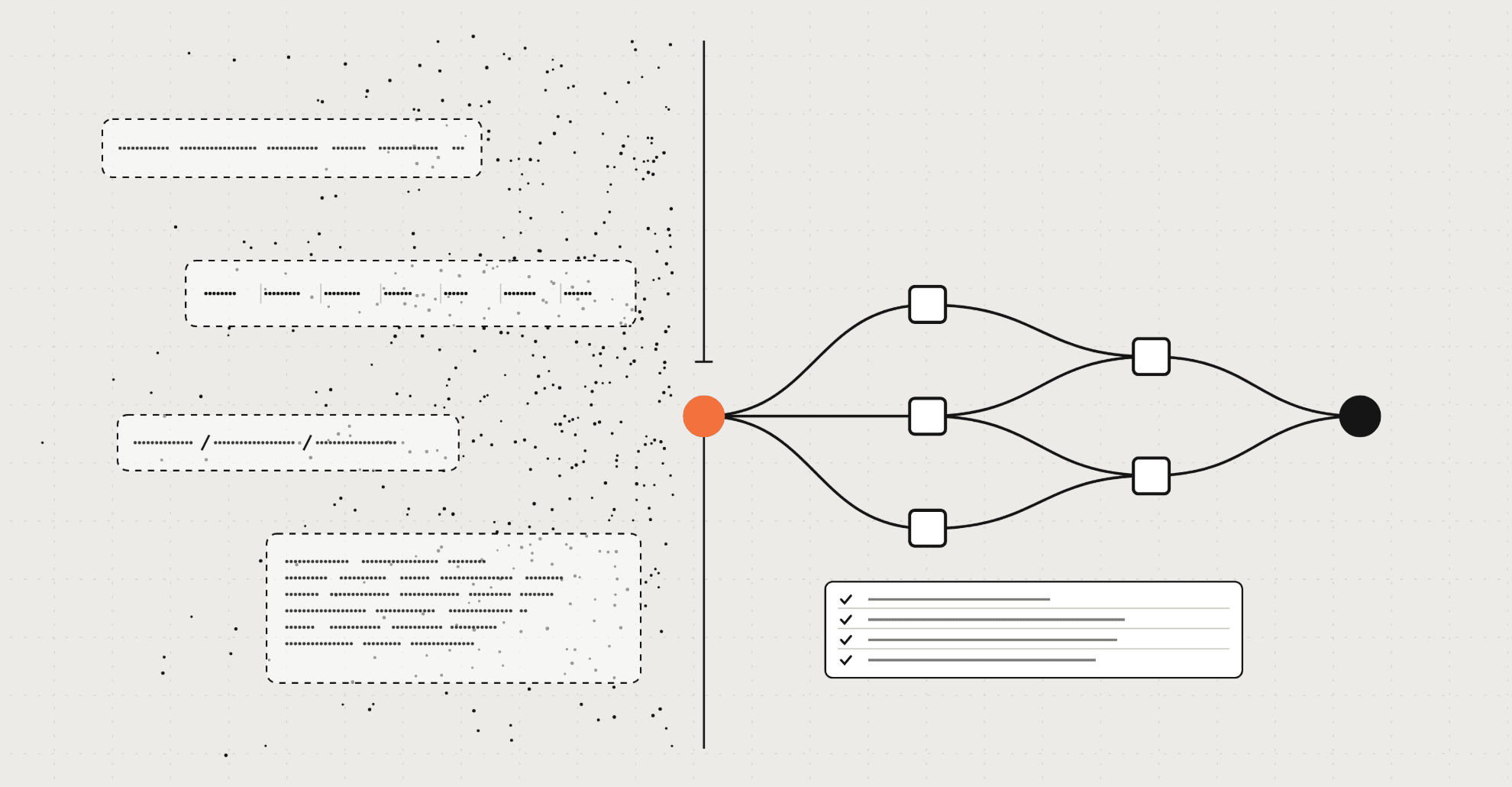
The Everysk trade operations workflow: one connected flow, from source data to settled book. Execution remains in your OMS/EMS.
Your data, in whatever schema fits
The platform adapts to your data rather than forcing your data into ours. Inputs arrive in whatever form your systems produce them, whether an API feed, an SFTP file, an emailed blotter, or a PDF, and Everysk parses, normalizes, and structures them into relational data stores that mirror your firm’s own conventions. Mapping tables, prime-broker priority matrices, fund attributes, and allocation schemes all live as configurable tables, so block trades can be split across brokers, funds, and accounts using the exact schema your processes already assume.
The allocation engine in motion
Allocation is the clearest example. As fills arrive, the engine ingests and parses each trade, evaluates the position math behind it, applies your allocation and marking rules, splits or marks the child trades, and pushes the corrected records back to the blotter via API. Reference data, including start-of-day positions from the prime broker and your firm’s rule set, feeds in alongside. What used to be a manual, single-operator pass becomes a workflow that re-runs continuously as new trades land, with a per-trade audit record waiting at the end.
Built around your constraints
No two firms allocate the same way, so constraints are configured rather than hard-coded. The engine enforces them across several dimensions at once: regulatory thresholds such as HSR limits, 13F, and ADV caps; mandate rules such as sector limits, restricted lists, and instrument eligibility; and operational realities such as lot sizing, rounding, partial fills, and T+1 cutoffs. When a constraint binds, the engine surfaces the maximum allocatable notional, records why a fund was excluded, and routes the exception to your team. You also set the governance level, ranging from fully automated to approval gates, where a PM or compliance officer signs off, to exception-only handling. Your operations team configures all of it, not your IT department.
A working case: automating Reg SHO order marking
Consider a credit-focused hedge fund whose trade operations team runs a daily Reg SHO order-marking pass against the OMS blotter, where traders book everything as a plain “Buy” or “Sell.” Someone has to decide, trade by trade, whether a fill closes a short, opens one, or crosses zero, and then flip “Buy” to “Buy to Cover” and “Sell” to “Sell Short” wherever the rule requires it. The logic breaks into several categories spanning bonds, Treasuries, and ETFs, each with its own position test. With trades arriving by the hundreds, the pass has to be rerun throughout the day. Everysk replicates that category logic against the bulk blotter, reads each position’s start-of-day quantity, and applies the amendments automatically, leaving a defensible audit trail behind every marking decision.
Just as important, the firm’s own operators can add tickers, adjust thresholds, or toggle a category on or off through self-service data stores, with no vendor development cycle. The logic remains molded to their process as that process evolves, which is exactly the point: the firm keeps control of its own rules while manual effort disappears.
That is the pattern across trade operations: the value is not in any single system; it is in the connections between them and in the firm-specific logic those connections must carry. The demands on trade operations will continue to evolve; the advantage goes to firms whose operations can absorb that change without adding headcount or risk. Everysk is the engine that holds it together, configured by the people who know the process best, and, as an ever-evolving partnership, it keeps getting better at what it does. One connected flow, from order to book.
About Everysk
Everysk Technologies is a New York-based fintech company providing intelligent automation and risk analytics solutions for capital markets. Our no-code platform enables asset managers, hedge funds, and wealth platforms to design, automate, and scale investment workflows across risk management, analytics, reporting, and compliance. Founded by investment professionals, Everysk helps firms modernize operations while maintaining transparency, control, and institutional rigor.
Follow Everysk on LinkedIn for the latest updates.
To learn more about how Everysk handles counterparty data feeds, reconciliation, and compliance, or to request a demo, get in touch with our team.