

Trade Allocation at Scale
One block order for two hundred accounts, each one with its own specific rules and constraints.
This is the daily reality for any investment manager running a growing SMA book alongside a flagship fund. A portfolio manager places a single equity trade, which sounds straightforward, but when the order needs to be split across various sub-accounts and SMAs, the trading process fractures into a compliance maze with account-level restrictions, differing tax lot rules, and fair allocation policies that cannot be easily applied at scale.
For years, trade operations teams managed this complexity through spreadsheets, emails, internal scripts, and manual overrides. As client accounts grow, the approach is no longer sustainable. With SMA assets projected to grow by more than $400 billion by 2027 and nearly 50% of hedge fund managers already running SMA structures, the operational burden has outpaced what manual workflows can support.
Why SMA Allocation Is Fundamentally Different From Fund Allocation
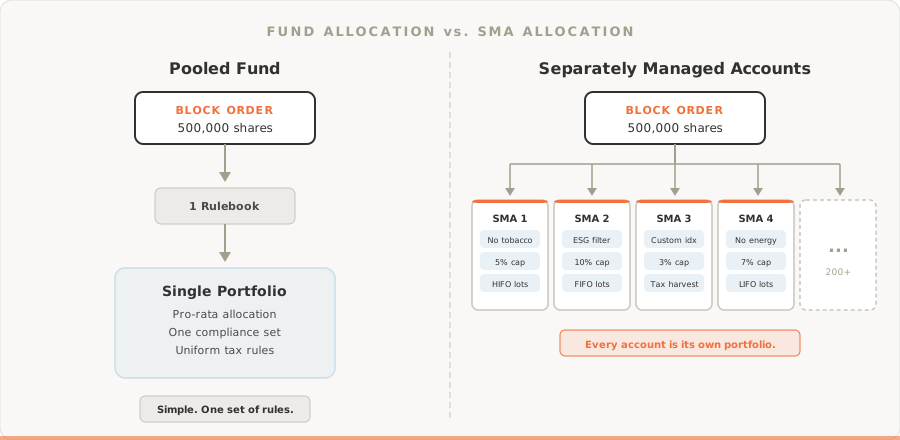
In a traditional pooled fund, allocation is simple: every investor owns a proportional share of the same portfolio, governed by one rulebook. The fund’s compliance framework, trading policies, and execution logic can, in most cases, apply uniformly.
SMAs invert that model. Each account is its own portfolio, governed by its own investment policy statement, restriction list, and tax sensitivity. One SMA might exclude tobacco companies. Another has a 5% single-issuer cap tighter than your standard mandate. A third is benchmarked against a custom index that changes the lot selection calculus entirely.
When the PM places a block order, the post-trade allocation there is a rules-resolution problem:
- Which accounts get filled first?
- How are partial fills distributed when liquidity is thin?
- Which accounts are exempt from this trade entirely based on their restriction set?
- How does the allocation hold up to a best-execution audit six months from now?
Manually running this process for a book of 50, 100, or even 200 accounts transforms a simple operations workflow into a significant full-time compliance liability.
Where Manual Trade Allocation Breaks Down
The failures are not sudden or dramatic; instead, they accumulate quietly over time.
Restriction drift. Client agreements may be updated with new account-level restrictions, but this information often fails to reach the allocation logic in a timely manner. The next block trade goes out, one account gets a fill it shouldn’t have, and the error surfaces days later, rather than at the time of trading.
Inconsistent partial fill treatment. When a block order is only partially filled, most teams default to a pro-rata distribution. But pro rata doesn’t always comply with fair allocation, and it isn’t always defensible, particularly when accounts may have individual constraints, such as eligibility or buying power.
Audit trail gaps. In review, when compliance identifies that Account 147 received a different allocation percentage than Account 148 on the same block trade, the answer must be documented, timestamped, and accessible. Spreadsheet-based workflows don’t sync across desks and platforms, leaving information unavailable when needed.
Headcount dependency. The operations or IT analyst who built the allocation model in Excel three years ago is now a single point of failure. The knowledge lives in their head, not in the system.
T+1 compression. Since the SEC’s T+1 settlement mandate took effect in May 2024, allocations, affirmation, and SSIs must be completed on the trade date. Any manual process in the allocation chain is now a potential T+1 failure point, not something to be reviewed and cleaned up the following day.
Each of these is manageable on a small scale. With 50-plus accounts, any one of them poses a material operational risk to trading desks.
What Automated SMA Trade Allocation Actually Requires
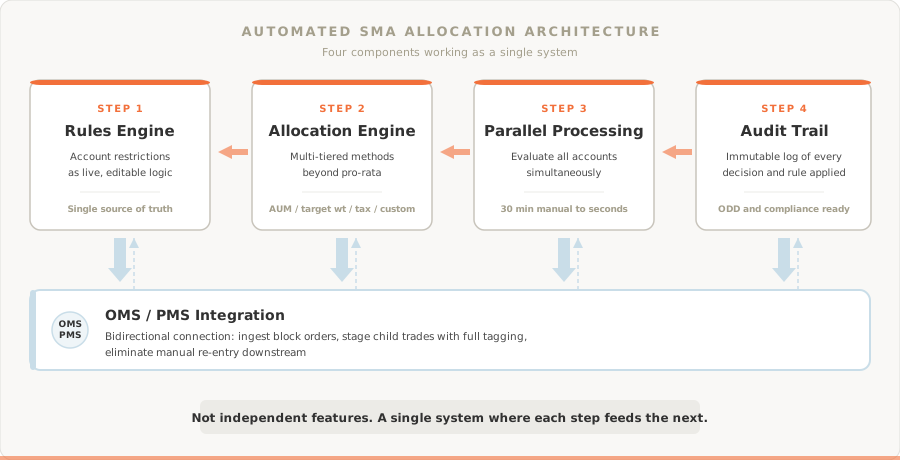
Automation here doesn’t replace human judgment; instead, it codifies the logic to ensure that every execution is consistent and auditable. This defines the process and makes it repeatable. The architecture comprises four components:
A rules engine that holds account-level constraints as live, editable logic
This is not a static spreadsheet column that requires manual monthly updates; this active system evaluates the workflow for every order in real time. When a restriction is updated, the change occurs in a single location and is instantly applied across the entire system.
Multi-tiered allocation methodology beyond pro-rata
Sophisticated allocation engines support a hierarchy of approaches: pari passu by AUM, target weight alignment, lot-level optimization for tax sensitivity, capital-weighted sequencing, and custom override logic for specific security types or account categories. The right method depends on the trade, the account, and the mandate. An allocation workflow applies that logic without requiring a human decision each time.
Parallel processing across the entire account book
Evaluating each account sequentially against its restriction set only increases reliability, but it can also increase execution time. The right workflow system fans out compliance evaluation across all accounts simultaneously via parallel processing, then aggregates the results before staging child orders to the OMS and sending them out. What previously took 30-45 minutes of manual work runs in seconds.
A complete, immutable audit trail linked to the rule that drove each decision
For complete auditability, every allocation decision, including the timestamp, the specific constraint that led to an account’s exclusion, and the allocation methodology used, must be automatically logged and attached directly to the order record. That log needs to survive a compliance inquiry and an ODD review without requiring anyone to reconstruct it from memory.
Integration with an OMS
Allocation logic that lives in a silo, outside the order management system, creates reconciliation overhead and risk of errors. The most effective implementations connect the rules engine directly to the OMS and enable child trades to be staged with full tagging (strategy, vehicle, prime broker, custodian instructions), so operations don’t have to re-enter data downstream to manually add or edit information.
How Trade Allocation Workflows Run in Practice
Consider a fund running a flagship strategy alongside 80 SMA accounts. The PM places a block buy order for 500,000 shares of a single name.
In a manual workflow:
- The trader exports the order to Excel
- Runs the allocation model
- Manually checks restriction lists for each SMA
- Resolves conflicts, calculates lot sizes
- Re-enters child orders into the OMS
- Records actions in a separate spreadsheet
Under T+1, this entire process has to be completed by the end of the trade date.
In an automated workflow:
- The order is ingested directly from the OMS blotter.
- The platform retrieves the account metadata, including each SMA’s restriction set, allocation scheme, and prime broker configuration.
- A compliance workflow runs in parallel across all 80 accounts.
- Accounts with applicable restrictions are automatically flagged and excluded.
- The remaining accounts receive allocations based on the defined methodology.
- Child trades are formatted to OMS spec and staged in the OMS with full audit documentation.
- The PM and compliance officer receive a notification with the allocation summary and any flagged exceptions for approval.
The entire process runs in under a minute. The audit trail is complete before the first fill.
Everysk Trade Allocation Workflows
Everysk automates the full trade allocation process for funds globally by implementing custom logic, rules, reporting, approvals, and OMS integrations to provide a robust, scalable, and auditable solution.
This comprehensive automation is essential for managers dealing with Separately Managed Accounts (SMAs) and other complex structures where trades must be precisely distributed across hundreds, or even thousands, of individual client accounts.
Key features of Everysk’s automated allocation solution include:
- Custom Logic and Rules: The system is configured with each client’s unique allocation methodology, handling complex scenarios such as pro rata, discretion-based, or specific account-level restrictions.
- Real-Time Reporting and Audit Trails: Every step of the allocation process is logged and auditable, providing an immutable record for compliance, client reporting, and internal review. This includes pre-trade compliance checks and post-trade reconciliation.
- Seamless OMS/PMS Integrations: Everysk connects directly with major Order Management Systems (OMS) and Portfolio Management Systems (PMS) to ensure a smooth, end-to-end workflow, from trade generation to final execution and settlement.
- Digital Approval Workflows: We implement custom approval hierarchies that enable portfolio managers, compliance officers, and operations teams to review and sign off on allocations digitally, dramatically speeding up the entire cycle while maintaining strict control.
By transforming this critical operational function from a manual burden into a fully automated, transparent, and controlled process, Everysk empowers fund managers to scale their SMA offering, reduce operational risk, and focus on investment performance.
- Multi-Broker Order Splitting Workflow: parallel allocation logic across broker accounts using custom metadata mapping
- Pre-Trade Compliance Automation: real-time compliance evaluation at order generation, before execution
- Trade Approval Automation Workflow: human-in-the-loop approval gates embedded within automated workflows
- Portfolio Rebalancing at Scale: rebalancing thousands of portfolios in parallel with customizable allocation logic
- Internal Trade Crossing: crossing opposing orders across accounts before routing externally
What to Look for in a SMA Trade Allocation Platform
Not all automation platforms are built for the complexity of institutional SMA management. Key questions to ask:
Can the platform natively support and enforce account-level restriction sets? Or does the restriction logic live in a separate spreadsheet that someone reconciles with the allocation output?
Does it support multiple allocation methodologies with configurable sequencing? Pari passu, capital-weighted, target-weight alignment, and custom override logic should all be available and selectable at the account or mandate level.
What does the audit trail actually look like? Request a sample allocation log. It should show the rule applied, the accounts evaluated, the fills distributed, the rationale for any omitted accounts, and the timestamp, in a format accessible to both internal reviewers and external auditors.
Does it integrate directly with your OMS, or does it require manual entry? If allocation logic generates a spreadsheet that someone then uploads to the OMS, you’ve automated the math but kept the error risk.
Can the system handle parallel processing across hundreds of accounts without re-architecture? If the answer changes between 50 and 200 accounts, there’s a product limitation that can limit your ability to scale client account growth.
Does it support human-in-the-loop checkpoints without breaking the automation? The right architecture allows compliance officers or PMs to review and approve allocations before execution, with the workflow paused and automatically resumed after approval, eliminating manual re-initiation.
The Bottom Line
The SMA market isn’t slowing down. Allocators increasingly prefer the transparency, customization, and governance control that SMAs offer over pooled structures, with JP Morgan projecting 58% of new fund launches will be catered to SMAs going forward. For managers, this is a growth opportunity that requires the appropriate technology.
The most successful SMA managers embed trade allocation logic directly into their systems, rather than relying on massive operations teams. The automations provide more than a minor efficiency improvement; this is the critical difference between building a business that can scale client account growth and a fund that plateaus after its initial clients are onboarded.
If your current SMA allocation workflow depends on a spreadsheet, an internal script, or a single analyst, centralizing trade operations can dramatically reduce the operational burden and inherent risks associated with managing hundreds, or even thousands, of client accounts.
Everysk automates trade allocation workflows for investment managers running complex trade allocation and compliance structures, from rules-based allocation engines to full front-to-back workflows. See how it works →
For a deeper look at the architecture behind this pipeline, including how agentic AI handles unstructured trade instructions before the deterministic allocation logic takes over, see Neither Robots Nor AI Alone: Why Capital Markets Need AI-Embedded Automations.


